
How to Get Court Records
Identify the court before ordering a Zapata County record. District civil, criminal, family, and juvenile files go to the District Clerk. Constitutional County Court, probate, guardianship, wills, and county civil or criminal files go to the County Clerk. A citation, small claim, or forcible-detainer file stays with the issuing Justice of the Peace precinct.
Search iDocket for the district path or use the service linked by the County Clerk. If the image is absent, call or visit the custodian. Mail and fax details are published, but acceptance, fees, and delivery time should be confirmed first. Rule 12 governs written access to qualifying judicial records outside ordinary case files.
- Name the court and exact record needed.
- Search the official local or statewide portal.
- Record the cause number, case style, and filing date.
- Ask the custodian about online, counter, mail, or fax delivery.
- Specify a plain or certified copy and confirm the fee.
Zapata County Custodian Map
Both clerk offices share the courthouse. They do not share record series. The District Clerk is the custodian for the 49th Judicial District Court. The County Clerk serves the Constitutional County Court and keeps probate and related county records. Each JP office runs its own justice-court docket. A request sent to the wrong suite can stall for weeks or come back with a mistaken "no record" answer, so match the office to the case first.
| Record | Custodian | First Path |
|---|---|---|
| District civil, criminal, family | District Clerk | iDocket or clerk request |
| County and probate matters | County Clerk | LGS link or clerk request |
| Citations and justice cases | Issuing JP | GovRec or precinct office |
The case type and issuing court tell you more than the loose phrase "county record" ever will. The District Clerk page and the Justice Courts directory list the local office routes.
Types of Court Records
A Zapata County court file can hold quite a range. Expect an index, docket or case history, pleadings, motions, orders, judgments, citations, financial entries, and public exhibits. What you actually get depends on the jurisdiction and the access status of the case. Probate files may add applications and estate orders. Justice files tend to turn on a citation, claim, service, payment, plea, or final disposition.
- Docket sheets and chronological case histories
- Petitions, answers, motions, and other pleadings
- Signed orders, judgments, and disposition records
- Public exhibits and attachments
- Costs, payments, credits, and receipt entries
Official land and property records are a separate County Clerk series. Searching that series is not the same as a court docket search, even when both tools sit on the same office page.
Rule 12 Written Requests
Courts in Texas answer to different access rules than executive agencies do. The Texas courts open-records policy spells this out: the Texas Public Information Act does not reach courts the way it reaches agencies. Instead, Texas Rule of Judicial Administration 12 governs public access. That rule covers judicial records beyond ordinary case records. The item you want, the custodian who holds it, and any appeal route all hinge on which kind of record it is. That line matters.
A written request works best when it is specific. Name the court and custodian. Give the cause number or case style, set a date range, list the document type, and state the format you want. If part of the file may be confidential, ask for the public portion. Keep copies of the request and the reply. Rule 12 builds in written-denial and appeal procedures, so those papers matter. The OCA policy page is the state's own statement of that access distinction.
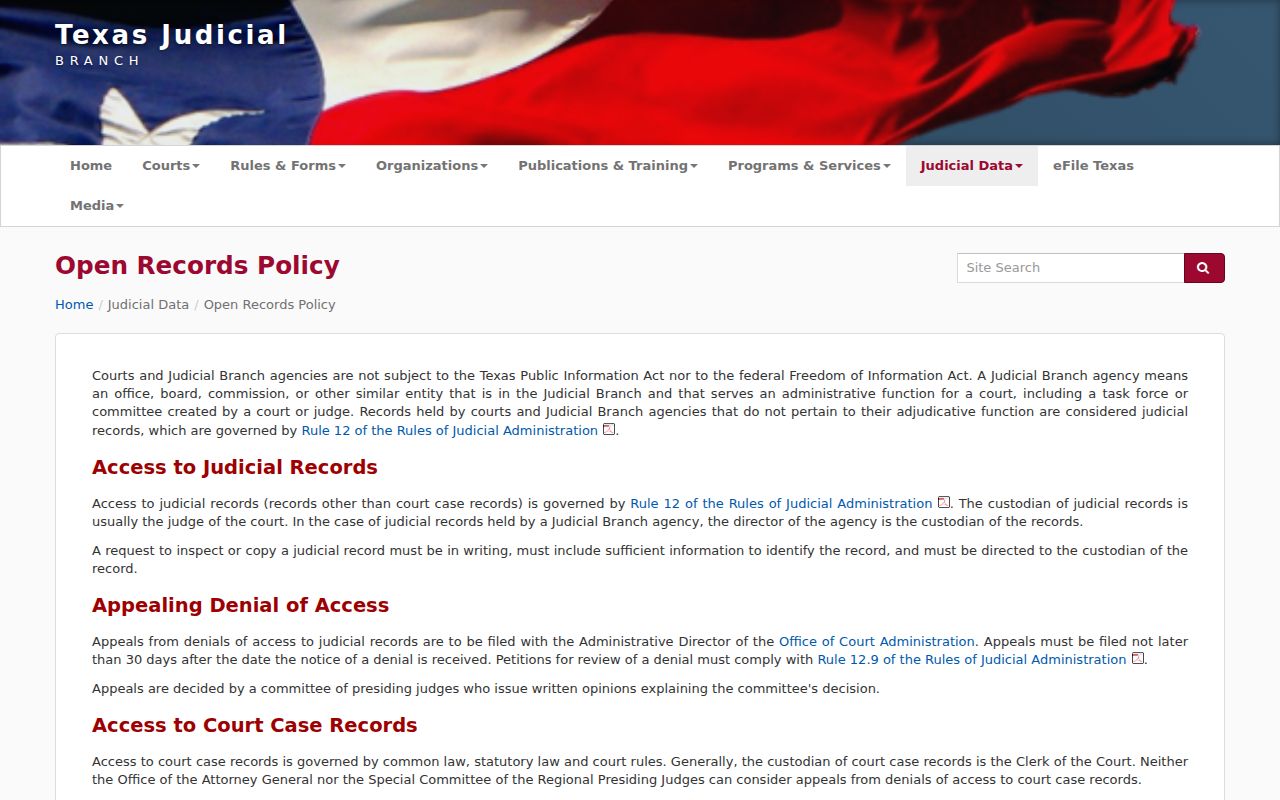
The state policy tells you how to route the request; the Zapata County custodian actually retrieves the local record.
What a Court Record Contains
Think of a docket as the index or timeline. The case file holds the real papers behind it. iDocket labels its activity view "case history," which can list documents, actions, motions, orders, citations, costs, payments, and ledger events. Calendar data may live somewhere else entirely. That is why a record can show a filed motion even when the public calendar lists no setting for it.
| Cause Number | The court-assigned identifier, copied exactly. |
|---|---|
| Pleadings | Petitions, answers, motions, and notices released to the public. |
| Orders | Signed rulings or judgments available in the file. |
| Docket | A chronological index of public case actions. |
| Ledger | Costs, assessments, payments, credits, refunds, or receipts. |
A portal status never replaces the text of the final order. When the exact disposition matters, request that order itself.
Zapata County Online Image Limits
Guest access on iDocket may reveal a name and cause number. Fuller history or images often require a subscriber account. Image access also depends on which counties participate and what must be redacted. The County Clerk's LGS link is unreliable. Treat no fixed search fields or instant documents as guaranteed there.
re:SearchTX adds a statewide option. It covers cases, filings, hearings, tracked cases, and some document purchases. Its coverage has limits. State integration does not place every Zapata County historical file or image in one basket. When an image is missing, the responsible clerk remains the place to verify it.
Note: eFileTexas receives electronic filings, but it is not itself a public court-record search.
Certified Copies and Fees
A plain copy just reproduces the public record. A certified copy carries the clerk's certification, which is often what another institution wants before it accepts a court paper. Say which one you need before paying. The January 2024 County Clerk schedule lists that office's amounts; it does not set District Clerk or JP fees.
| County Clerk Item | Located Amount |
|---|---|
| Official-record copy | $1 per page |
| Certification | $5 plus page charges |
| Lien search | $5 per name |
| Outgoing fax | $4 first page; $1 each additional |
These amounts come from the County Clerk schedule effective January 2024. Check that no newer schedule has replaced it. For District Clerk and JP copy or certification costs, ask those offices directly.
Probate and Guardianship Records
For probate, wills, guardianship, and safekeeping files in Zapata County, the County Clerk is where you start. That office also issues certified copies. A probate and guardianship fee sheet covers the costs for this route. One caution: an online property-record result is not the probate case file. The actual court record can include an application, notices, service papers, inventories subject to access rules, and signed orders.
When you contact the clerk, give the decedent or case style. Add the approximate filing date. Give the cause number if you have it, plus the exact instrument you need. Ask two questions. Is the image public? Does the request need certification? Even when the case index is visible, protected personal or financial material may be redacted.
Public Access and Sealed Records
Plenty of Zapata County court records are public in whole or in part. Privacy rules still apply. A docket may show that an item was filed while the image itself stays sealed. Juvenile, expunged, and nondisclosed material may be withheld. So may some family and probate files. Rule 21c requires redaction of listed identifiers and personal information.
Key Texas rules:
Rule of Judicial Administration 12 governs access to judicial records outside ordinary case records.
Texas Rule 21c requires omission or redaction of specified sensitive data.
Family Code Chapter 58 gives juvenile records special confidentiality and sealing rules.
Ask for the public portion of the file, not an unredacted copy. A clerk cannot hand out material that a statute or court order protects.
Federal Records Leave Zapata County
Federal cases touching Zapata County never sit with either county clerk. The Southern District of Texas Laredo Division serves the county. Federal civil or criminal dockets are generally searched through PACER. Bankruptcy goes through the Southern District bankruptcy CM/ECF system. Appeals use Fifth Circuit case systems. Knowing this boundary saves you a wasted local request.
Probation, immigration, agency, and law-enforcement records are not county court files either. They stay outside unless a public filing puts information into a case. Read the caption closely. Turn to the Laredo Division only when the caption or notice identifies a federal court.
That federal clerk does not replace the county route. A 49th District Court, Constitutional County Court, or JP file still starts with the local clerk. Texas appeals from Zapata trial courts ordinarily pass through the proper intermediate appellate court. The Fourth Court of Appeals lists Zapata among its counties. Its appellate docket is maintained by that court, not the local trial clerk.