
How to Search Zapata County Criminal Dockets
Begin with iDocket, the case-management system identified for the Zapata District Clerk. Its public menu offers name, cause-number, advanced, and calendar searches. A guest name search can help identify a cause number, though detailed case history or document images may require subscriber access. Select Texas, Zapata County, the right court, and the criminal category before using a name.
No official source reviewed publishes a Zapata-specific cause-number pattern. Do not invent one. If the number is unknown, use the defendant name and court filters or call the correct clerk. Broad searches can use a partial name or Soundex; a date, initial, case type, or court can narrow a long result list.
- Open iDocket and select Texas, Zapata County, and the court that fits the charge level.
- Search by litigant name, or enter the exact cause number when it is known.
- Compare the court, category, filing date, and party role before opening a result.
- Read charges, actions, settings, plea, and disposition as separate fields.
- Ask the District Clerk, County Clerk, or correct JP for an official copy when needed.
Zapata County Criminal Dockets Start With the Court
Criminal jurisdiction in Zapata County is split by offense level. The 49th Judicial District Court handles district-level criminal work, including felonies, and the District Clerk keeps that docket. The Constitutional County Court handles Class A and Class B misdemeanor functions, with the County Clerk as custodian. Fine-only Class C misdemeanors and citations go to one of four Justice Courts.
This split explains why one broad search may not answer the question. A citation should be matched to its JP precinct, while a felony file belongs on the district path. The official Justice Courts page lists the four precinct offices and links their citation service. The issuing court on a notice is usually the best routing clue.
What a Criminal Docket Shows
An iDocket case history may combine party and case identifiers with documents, actions, motions, orders, answers or citations, costs, payments, and ledger events. Visibility varies by account level and by the court's participation. A result is a research lead, not proof that every filed paper or hearing is shown.
| Cause number | The court identifier, shown as exact number from the clerk; local format was not documented. |
|---|---|
| Charge | Offense description, degree, category, or statute when the public record displays it. |
| Actions | Filed documents, motions, orders, answers or citations, and text events. |
| Setting | An arraignment, pretrial matter, hearing, or trial date, if calendar data is supplied. |
| Outcome | Status and disposition date, which should be checked against the signed order. |
| Ledger | Costs and payment entries, including documented iDocket codes such as A+, A-, TOF, RET, and SP. |
Reading Zapata County Criminal Case History Codes
iDocket distinguishes the case history from its calendar. Its help materials describe A+ as an assessment, A- as a credit or payment, TOF as payment credited, RET as a refund or change, and SP as money received or payment. A TXT line is a text entry. Those codes describe ledger or history activity, not the legal meaning of a charge.
A reference field can hold a check number or a volume and page citation to minutes. Document-image access is separate and may require a subscription or purchase. If a summary says closed or disposed but the basis is unclear, request the public order from the custodian before treating the label as final.
Stages on a Zapata County Criminal Docket
A filed charge creates the case record. Arraignment then confirms identity, addresses counsel, and takes a plea. Zapata County's Constitutional County Court page lists guilty, not guilty, and no contest as plea options. Pretrial motions and settings follow, then a plea or trial, a disposition, and sentencing where applicable. Each step may create a separate date, action, or order.
Docket flow: Charge Filed › Arraignment › Pretrial Settings › Plea or Trial › Disposition
Zapata County Arraignment and Motion Timing
The County Judge's court page gives a local instruction for county-court matters: motions must be received and filed by the County Clerk within ten days after arraignment. It also says plea-bargain arrangements are handled before the court date through County Attorney investigators. These instructions concern that local county-court process and should not be assumed to govern the District Court or a Justice Court.
Dates and filing rules can change, and a docket summary does not replace a court order. A person with a pending matter should confirm the current instruction with the clerk or counsel. Filing through eFileTexas also does not mean the pleading is instantly visible in the public iDocket history.
Zapata County Criminal Court Instructions
The official Constitutional County Court page is the source for local arraignment, plea, and motion instructions.
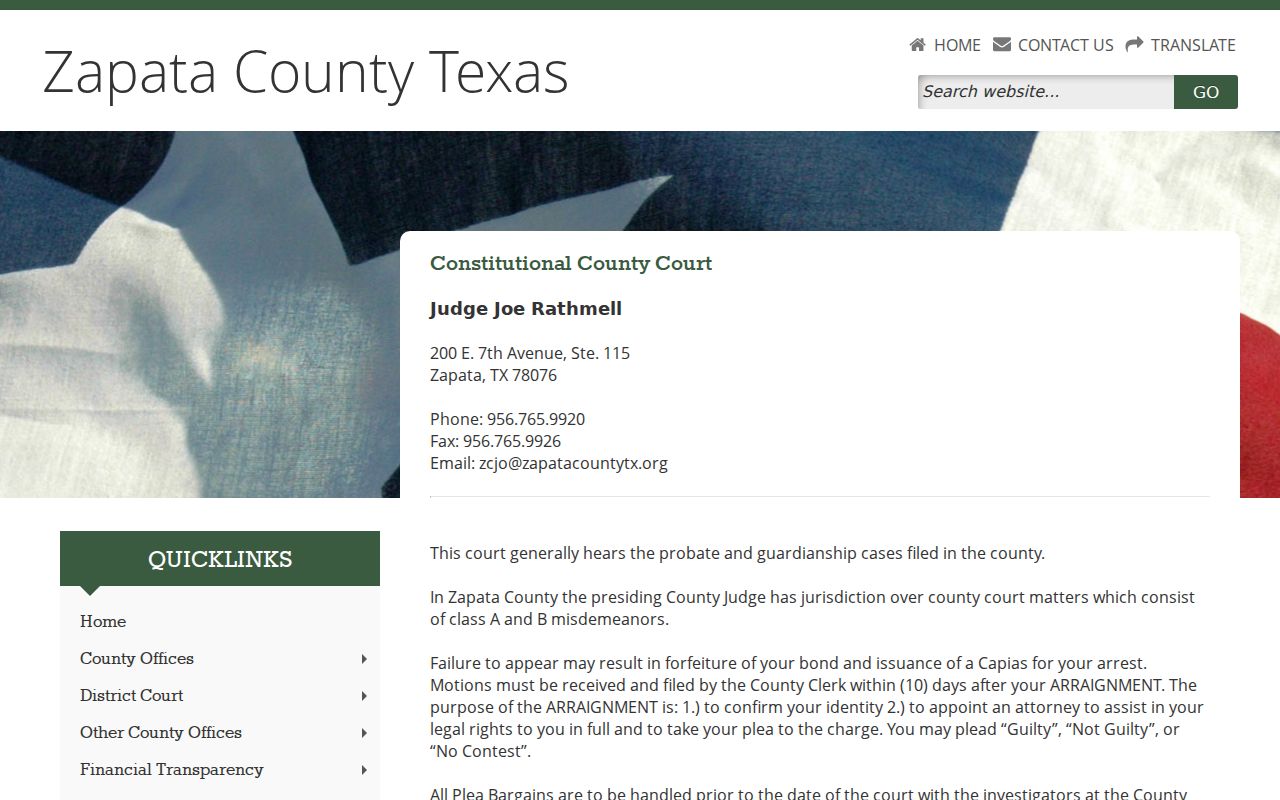
The captured county page should be checked again before relying on a date-specific direction, since court procedures and posted contacts can change.
Which Court Holds Criminal Dockets
Elva Alicia Garcia is the latest District Clerk identified in the 2026 Texas courts personnel directory. Her office in Suite 119 at 200 E. 7th Avenue keeps the 49th District Court's criminal files and can be reached at (956) 765-9930. The District Court itself is in Suite 330 and lists (956) 765-9935.
Mary Jayne Villarreal-Bonoan, County Clerk, keeps Constitutional County Court criminal files in Suite 138 and lists (956) 765-9915. Each JP maintains its own citation-level docket. Searchers may use iDocket, call the relevant office, visit the counter, or send a focused written request. Mail and fax details are published, but acceptance method, cost, and turnaround should be confirmed first.
Zapata County Criminal Caseload Context
Texas Office of Court Administration figures for September 2023 through August 2024 report 425 active district criminal cases at the start of the period, 355 added, 365 disposed, 15 placed inactive, and 400 active at the end. The same report lists 147 family-violence criminal cases added and 154 disposed within the district criminal totals.
These are aggregate workload measures, not a directory of people or a substitute for a docket. They can help explain why a setting moves or why a file has several events, but they do not establish what happened in any one Zapata County criminal case. Check the cause-specific history and the signed disposition.
Zapata County Criminal Record Verification
A portal status should be checked against the court file when the exact outcome matters. iDocket may show a case category, filing date, status, disposition date, actions, and financial entries, but a summary label does not explain the signed order. A setting is also not a disposition. The hearing may be reset, cancelled, or held without every calendar detail appearing in the case history.
For a felony or other district matter, contact the District Clerk with the cause number, defendant name, court, and document title. For a Class A or Class B misdemeanor, use the County Clerk. A fine-only Class C case belongs with the issuing Justice Court. Ask for the public judgment, dismissal, sentence, or docket sheet needed, and specify whether an informational or certified copy is required. Current District Clerk and JP copy charges were not located in the official research, so callers should ask rather than apply the County Clerk's separate fee schedule.
A written inquiry can include the case style, date range, and preferred delivery format. Published mail and fax contacts do not prove that every office accepts a record request by that route, and email is not a guaranteed intake channel. Confirm the method, fee, turnaround, and redaction process before sending payment. This court-first workflow reduces the risk of treating a missing portal image as a missing case or mistaking an old name in a directory for the current custodian.
Public Access and Sealed Criminal Dockets
Public access is not the same as unrestricted publication. Courts may withhold or redact sensitive data, juvenile material, sealed filings, expunged records, or information covered by an order of nondisclosure. A missing case or image can reflect a legal restriction, limited portal coverage, or an account limit. The proper response is to ask the custodian, not infer an outcome.
Key access rules:
Code of Criminal Procedure Chapter 55A governs expunction.
Government Code Chapter 411 contains nondisclosure provisions and exceptions.
Family Code Chapter 58 addresses juvenile confidentiality and sealing.